

Standards logic
Checked at capture.
Standards logic checks each entry as it goes in, in every method on the job. Your inspection plan sets the job's procedures, and a signature needs a valid certificate for the method. In RT, VT, and UT, each indication is also checked against the acceptance limits as it's entered. The technician still makes every call.
What's different
How checking at capture works.
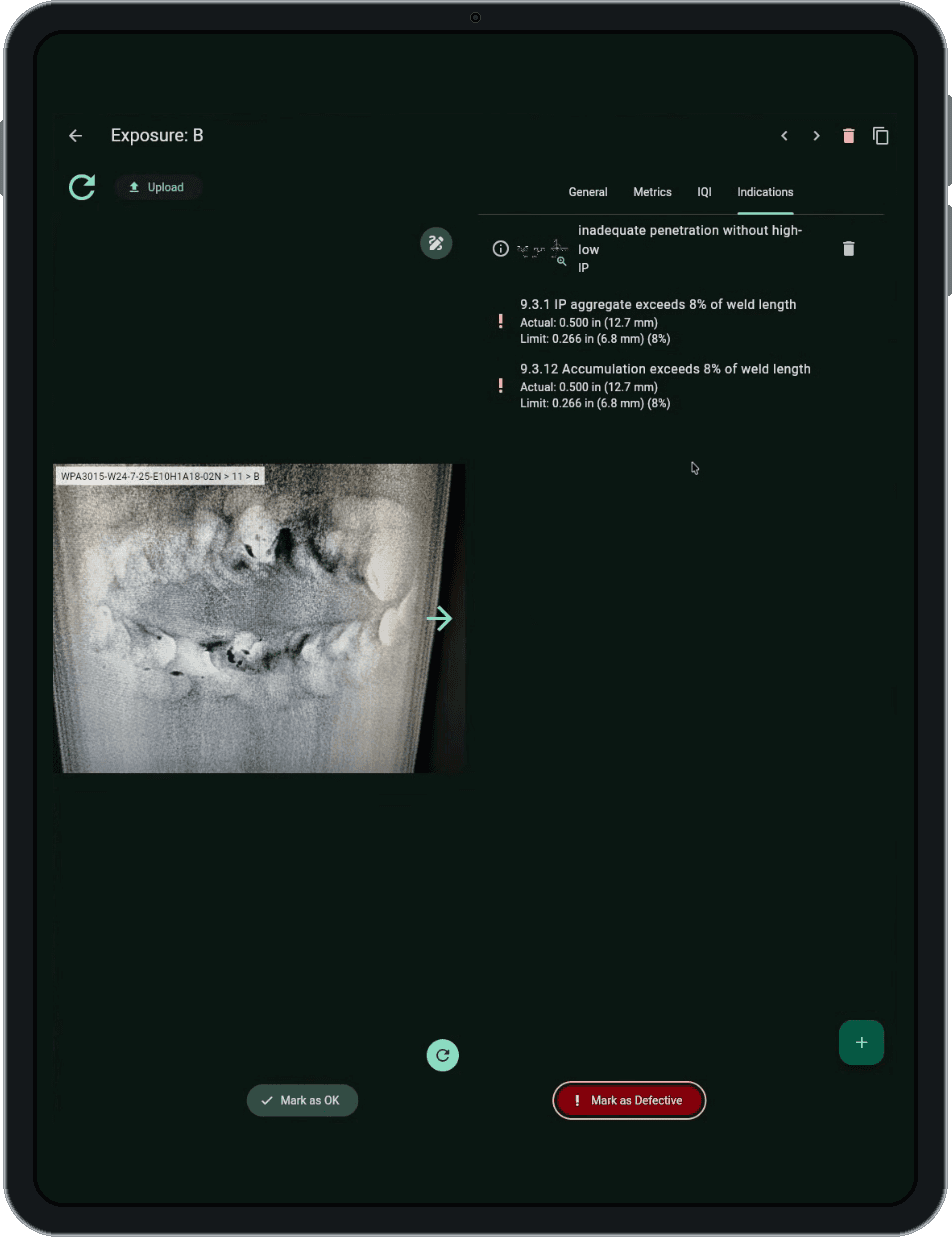
Most reporting tools check the finished report. A reviewer reads it, or a rule set runs before it's released. Weld Done checks each entry as it goes in. The job's code and acceptance criteria are set when the job is created, so nobody picks them from memory on site.
An indication outside the limits is flagged at the weld, with the clause, the measured value, and the limit. The technician still makes every call. If a tech deviates from the code, the app warns them and records why. Deviations from your own company policy, like an archived template or uncalibrated equipment, are blocked.
How it works
What the tech sees and the Evaluator signs.
The job starts from your inspection plan
Its procedures come with it. Adding one later needs a written reason.
Each indication is checked as it goes in
RT, VT, and UT indications, against the acceptance limits.
A reject shows its reason
The clause, the measured value, and the limit.
The second signer signs on the device
A signature needs a valid certificate for the method and level.
What it covers
What's checked, and what's recorded.
Checked
The job's procedures
Set from your inspection plan. Adding one later needs a written reason.
Each RT, VT, and UT indication
Checked against the acceptance limits as it's entered. A reject shows the clause, the value, and the limit.
Each signer's certificate
A signature needs a valid certificate for the method and level.
Recorded on every report
Job and weld identity
Client, job, location, weld ID, and the drawing it belongs to.
Procedure and material
The procedure, the material, and its thickness, as the code requires.
Technique and equipment
How the inspection was done and with what, recorded the same way every time.
Each indication and its call
What was found, where, and whether it's accepted or rejected.
Repair welds
A repair added after a rejected weld, examined as its own weld.
Names, cert levels, and sign-off
Who signed as Operator and Evaluator, on which certificate and level, and when.
Working with

Proof
Results measured in production.
Measured by Weld Done at Nordic NDT.
“I had to double-check and basically correct every report. With Weld Done, I don't have to do that double work anymore.”
FAQ
Questions.
Every other answer is on the FAQ page.
Can we lock technicians to one template and the right code?
Your inspection plan sets the job's procedures, and techs can't remove them; adding one later needs a written reason. Technicians pick from your templates for the method.
What does it check?
Each RT, VT, and UT indication against the acceptance limits as it's entered, and each signer's certificate and level at sign-off.
What happens when a tech calls a defect?
The tech makes the call. In RT, VT, and UT, a rejected indication shows the clause, the measured value, and the limit.
Which codes does it check against?
Codes for pipeline radiography, structural visual testing, and pressure-vessel UT are built in. Your inspection plan sets which procedures each job uses.

See your own report rebuilt.
Book a 30-minute demo on one of your real reports.
Not ready to talk? The calculator works out hours and costs back from your own numbers.